

Scalping targets 3 to 10 pips per trade on 1-minute and 5-minute charts, so costs, discipline, and mechanical rules decide results. No single setup wins everywhere, but the 5-minute EMA pullback and the 1-minute VWAP bounce are reliable starting points on liquid pairs like EUR/USD, GBP/USD, and USD/JPY during the London and New York overlap.
The article presents ten strategies, each with timeframes, indicators, entry rules, stop-loss placement, risks, and ideal trader types: an ECN account setup with spreads from 0.0 pip, moving average crossovers, RSI 7 momentum, range breakouts, pullbacks to the 20 EMA, Bollinger Band range fading, support and resistance price action, tick volume with MACD confirmation, fast stochastic timing, and ZigZag swing trading using only confirmed pivots.
Common threads include using a higher-timeframe trend filter, skipping trades around news, avoiding wide spreads, and risking only 1% to 2% per trade with a stop-loss. Traders should test one setup across 30 logged trades on a small Cent account before moving to ECN, since forex and CFD trading carries significant risk.
Scalping rewards speed and discipline, and punishes everything else. You are chasing 3 to 10 pips per trade on 1-minute and 5-minute charts, so a sloppy setup or a wide spread eats your edge fast. If you are hunting for the best scalping trading strategy, you need concrete entries, exits, and indicators, not theory.
Here is the direct answer. No single setup wins in every market, but the EMA pullback on the 5-minute chart and the 1-minute VWAP bounce are the most reliable starting points for forex day traders. Both work best on liquid pairs like EUR/USD, GBP/USD, and USD/JPY during the London and New York overlap.
Below you will find 10 strategies, each with its timeframe, indicators, entry rules, and stop-loss placement. We also cover which account type suits scalping, because spreads from 0.0 pip on an ECN account matter more than any indicator. Practice with small size first, since forex and CFD trading carries significant risk.
1. ValeTax ECN account scalping setup
How it works
The edge here is cost, not an indicator. An ECN account gives you direct market access with spreads from 0.0 pip, and you pay a per-lot commission instead of a wide markup. For a scalper chasing 5 pips, that changes the math completely.
| ValeTax account | Spread from | Spread as share of a 5-pip target |
|---|---|---|
| ECN | 0.0 pip | 0% (before commission) |
| PRO | 0.6 pip | 12% |
| Standard | 1.2 pip | 24% |
| Booster | 2.0 pip | 40% |
When your target is 5 pips, every tenth of a pip you pay in spread is profit you never get back.
You run the setup on MT4 or MT5. Eligible users also get a free VPS, which keeps your orders fast and your platform online during a session.
Best timeframes and pairs
Use the 1-minute chart for entries and the 5-minute chart for direction. Stick to EUR/USD, GBP/USD, and USD/JPY, since these majors carry the tightest spreads and the deepest liquidity.
Timing matters as much as the pair. The London and New York overlap, roughly 8:00 to 12:00 ET, supplies the volume that makes small targets reachable. Avoid the rollover hour and the minutes around major news releases.
Entry and exit rules
Keep the rules mechanical so you can repeat them 10 or 20 times a session:
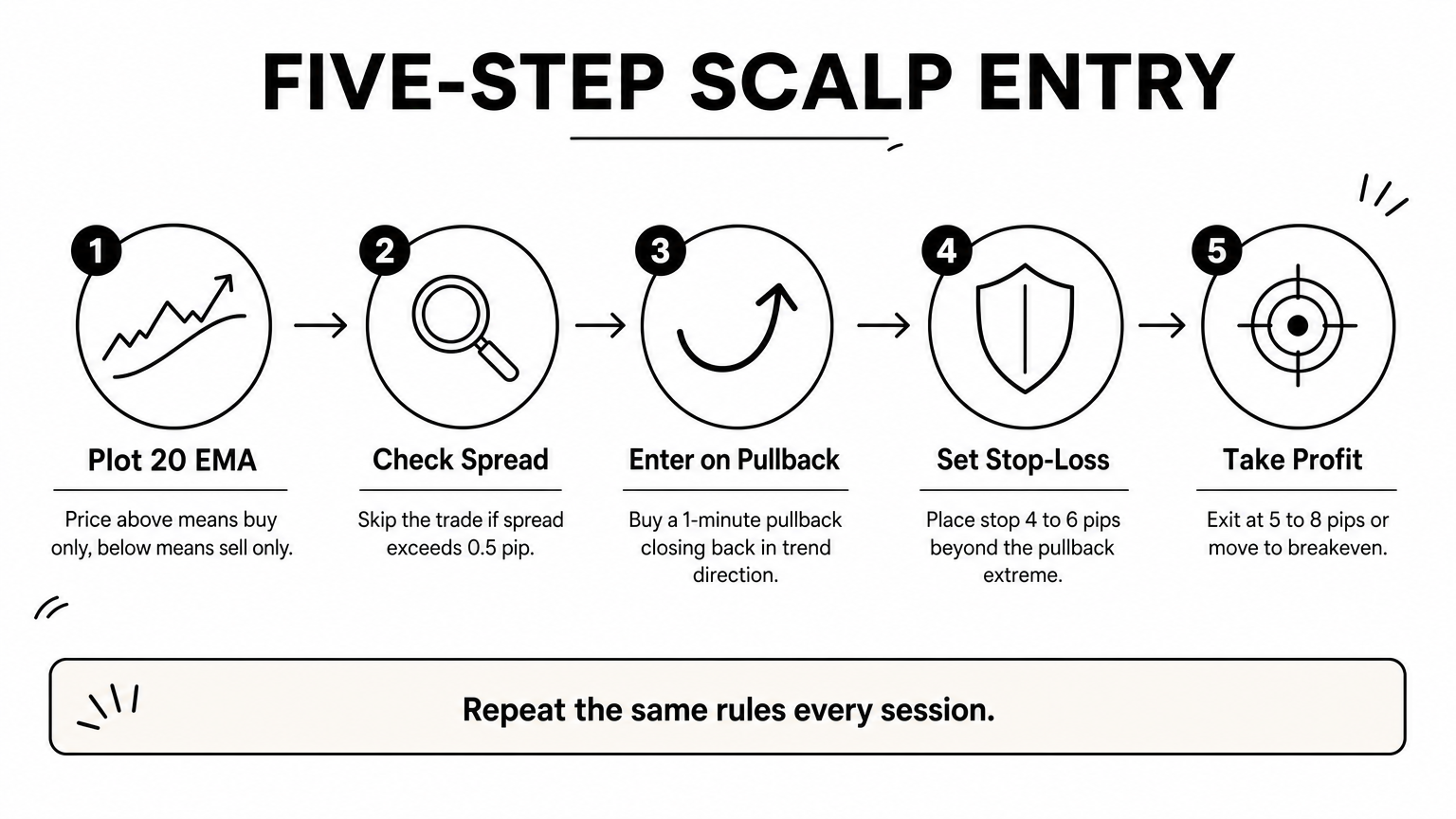
- On the 5-minute chart, plot a 20 EMA. Price above it means buy only. Price below it means sell only.
- Check the live spread. Skip the trade if it is wider than 0.5 pip on a major.
- Enter on a 1-minute pullback that closes back in the trend direction.
- Place your stop 4 to 6 pips beyond the pullback low or high.
- Take profit at 5 to 8 pips, or move to breakeven after 3 pips in your favor.
Who it suits
This setup fits active traders who can watch charts for two to four hours and place many small trades. If you already know your platform and want the tightest possible costs, the ValeTax ECN account is built for it.
Beginners should not jump straight in. Start on a Cent account from 1 USD to practice the rules with real money at tiny size, then move to ECN once your win rate holds up.
Main risks
Raw spreads are not free trading. The commission per lot still counts, so confirm the current rate and subtract it from every target before you take a trade. Slippage also rises sharply during news spikes, even on ECN.
Leverage up to 1:2000 is the bigger danger. It lets a few bad trades wipe out a small account in minutes. Risk 1% to 2% per trade, always use a stop-loss, and remember that forex and CFD trading carries significant risk.
2. Moving average crossover scalping
How it works
Two exponential moving averages do the work. When a fast 8 EMA crosses above a slower 21 EMA, you get a signal of rising short-term momentum. A cross below signals the opposite. The EMA weights recent price, so it reacts faster than a simple average.
Few rules mean few decisions. That makes this an easy scalping strategy for day trading forex, and a sensible first system if you are new.
Best timeframes and pairs
Run it on the 1-minute or 5-minute chart with EUR/USD, GBP/USD, or USD/JPY. The 5-minute chart gives fewer and cleaner signals, while the 1-minute chart gives more, plus more noise.
| Chart | Fast EMA | Slow EMA | Signal quality |
|---|---|---|---|
| 1-minute | 5 | 13 | Frequent, noisier |
| 5-minute | 8 | 21 | Fewer, cleaner |
Entry and exit rules
Keep the checklist short:
- Add the 8 and 21 EMA to a 5-minute chart.
- Wait for a cross, then for a candle to close on the correct side of both lines.
- Enter on the next candle open. Skip the trade if candles keep tangling between the lines.
- Place your stop 4 to 6 pips beyond the 21 EMA.
- Take profit at 1.5 times your stop, or exit if the EMAs cross back.
Who it suits
Traders who like visual, rule-based setups will feel at home here. If you dislike judging candle patterns, the lines make the call for you.
It also works well as a training system. You can test it on a Cent account from 1 USD and track every signal in a journal before you raise your size.
Main risks
Crossovers lag. By the time the lines cross, part of the move is gone, and in a flat market you will get a string of false signals that each cost a stop.
A crossover tells you a move has started, not that it will last, so filter every signal by trend and spread.
Avoid it when price chops sideways or when news is due. Cap risk at 1% to 2% per trade, since forex and CFD trading carries significant risk.
3. RSI momentum scalping
How it works
RSI measures the speed of recent price moves on a 0 to 100 scale. The default 14 period is too slow for scalping, so use RSI 7 instead. Most beginners fade the 70 and 30 levels, which fails in strong trends. The momentum version flips that logic and uses a cross of the 50 line to confirm that buyers or sellers are taking control again.
Best timeframes and pairs
Use the 1-minute chart for signals and the 5-minute chart for trend direction. EUR/USD, GBP/USD, and USD/JPY give the cleanest RSI swings during the London and New York overlap.
| Chart | RSI period | Pullback zone | Trigger |
|---|---|---|---|
| 1-minute | 7 | Below 40 (buys) or above 60 (sells) | Cross of 50 |
| 5-minute | 9 | Below 40 (buys) or above 60 (sells) | Cross of 50 |
Entry and exit rules
Keep the trend filter first and the RSI trigger second. Here is the buy side, and you simply mirror it for sells:
- On the 5-minute chart, confirm price is above the 50 EMA.
- On the 1-minute chart, wait for RSI 7 to dip below 40.
- Enter when a candle closes with RSI back above 50.
- Place your stop 4 to 6 pips below the recent swing low.
- Take profit at 6 pips, or exit early if RSI falls back under 50.
Who it suits
This setup suits traders who want one oscillator and one filter, nothing more. If you are searching for the best scalping trading strategy with a clean chart, this is a strong candidate. It is also a good scalping strategy for practicing patience, since you wait for a pullback instead of chasing.
Main risks
The 50 line whipsaws in flat markets, so you can take three or four small losses in a row. RSI can also stay stretched in a strong trend, which makes early exits tempting.
RSI shows momentum, so trade it with the trend and never against it.
Skip it when the 5-minute 50 EMA is flat. Risk 1% to 2% per trade, because forex and CFD trading carries significant risk.
4. Breakout scalping
How it works
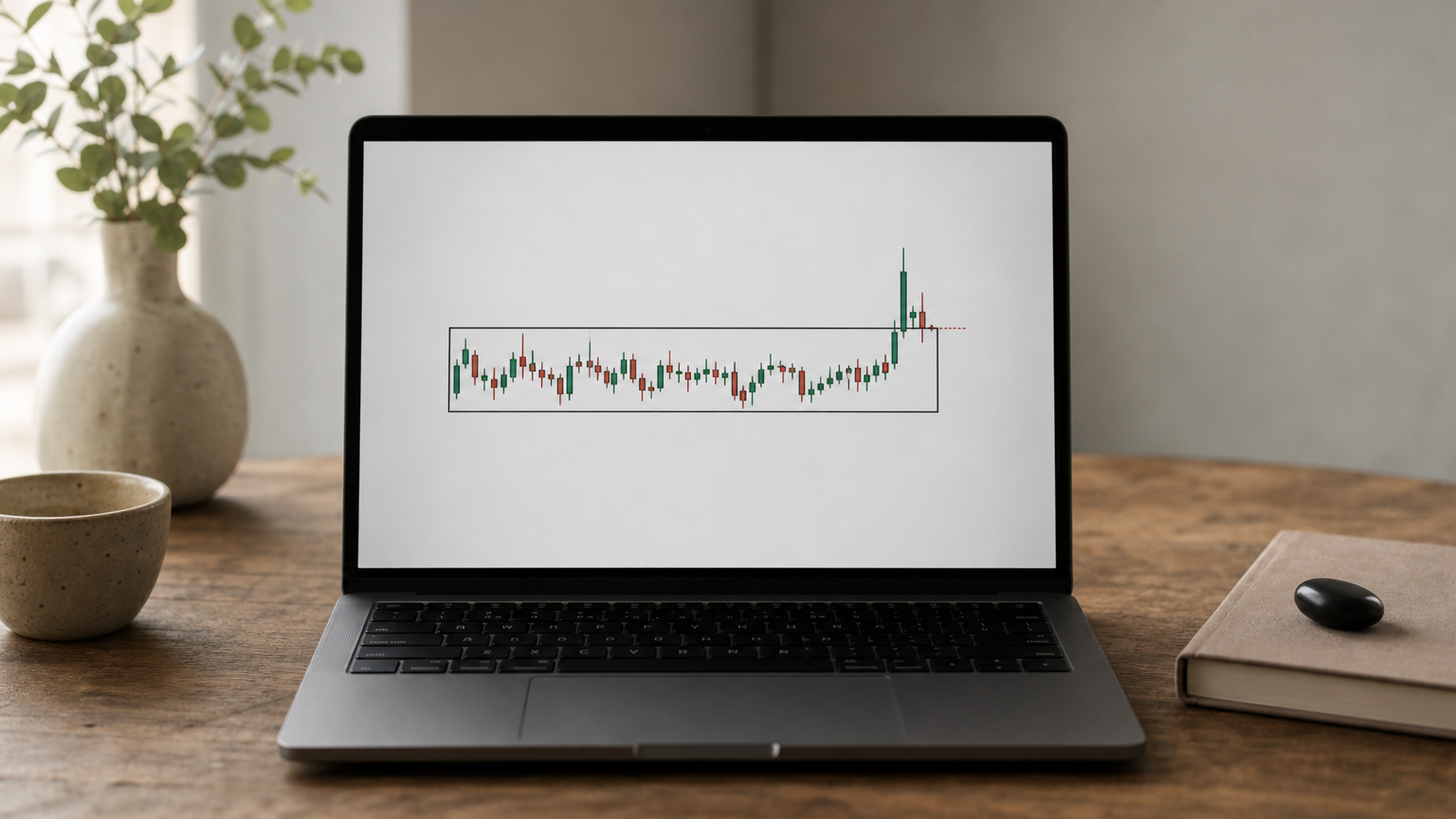
Breakout scalping targets the moment price escapes a tight box. You mark the high and low of a 15 to 30 minute consolidation, then trade the first candle that closes outside it.
Compression builds energy, and the first clean push often runs 5 to 10 pips before it stalls. The Asian session range breaking at the London open is the textbook case, and it is a strong contender for the best strategy for scalping during a quiet-to-active handoff.
Best timeframes and pairs
Draw the range on the 5-minute chart and execute on the 1-minute chart. GBP/USD and EUR/USD give the cleanest breaks, while GBP/JPY moves further but costs more in spread.
| Session | Window (ET) | What breaks |
|---|---|---|
| London open | 3:00 to 5:00 | Asian session range |
| New York open | 8:00 to 10:00 | Pre-market range |
Entry and exit rules
Keep the rules strict so you do not chase:
- Mark the high and low of the last 15 to 30 minutes. Skip ranges wider than 10 pips.
- Wait for a 1-minute candle to close outside the range with a body larger than recent candles.
- Enter on the next candle, or on a retest of the broken level.
- Place your stop just inside the range, capped at 6 pips.
- Take profit at 6 to 8 pips, and exit at once if price closes back inside.
Who it suits
Patient traders who prefer waiting for a clear level over trading every candle will like this one. It also fits you if you can only watch the market for an hour at the open.
Spread control matters here, because entries fire when quotes are fast and spreads can widen. A raw-spread account keeps that cost down.
Main risks
Fakeouts are the main killer. Price pokes through the level, triggers your entry, then snaps back and hits your stop.
A breakout is only real when the candle closes outside the range and stays there.
News releases make this worse, since slippage on stop entries can double your intended risk. Trade only closed candles, avoid scheduled releases, and risk 1% to 2% per trade, because forex and CFD trading carries significant risk.
5. Pullback and dip scalping
How it works
Strong trends move in waves. Price pushes, pauses, then pushes again. This strategy buys the pause, not the push, so your entry is cheaper and your stop is tighter. In an uptrend, you wait for a dip back to the 20 EMA or the 38.2% to 50% retracement of the last leg, then buy the bounce. For keeping stops small, it is the best scalping strategy on this list.
Best timeframes and pairs
Use the 5-minute chart for trend and the 1-minute chart for entry. EUR/USD, GBP/USD, and USD/JPY trend cleanly during the London and New York overlap, which gives you pullbacks worth trading.
| Chart | Job | Tool |
|---|---|---|
| 5-minute | Trend filter | 50 EMA slope |
| 1-minute | Entry | 20 EMA and a reversal candle |
Entry and exit rules
Here is the buy side. Mirror it for sells:
- On the 5-minute chart, confirm the 50 EMA slopes up and price sits above it.
- On the 1-minute chart, wait for a dip of 3 to 6 pips back to the 20 EMA.
- Enter when a bullish engulfing candle or pin bar closes at the EMA.
- Place your stop 3 to 5 pips below the dip low.
- Take profit at the prior high, usually 5 to 7 pips, or at 1.5 times your stop.
Who it suits
Traders who hate chasing candles will like this one. You wait for price to come to you, which builds patience and keeps your risk-to-reward near 1.5 to 1. It also suits you if you want fewer but cleaner trades per session, say five instead of twenty.
Main risks
A pullback can turn into a reversal. The dip that looked healthy keeps falling, breaks the 50 EMA, and takes your stop with it.
A pullback is only a buying chance while the larger trend is still intact.
Skip the setup when the 50 EMA is flat or when news is due. Cap risk at 1% to 2% per trade and always use a stop-loss, because forex and CFD trading carries significant risk.
6. Range scalping with Bollinger Bands
How it works
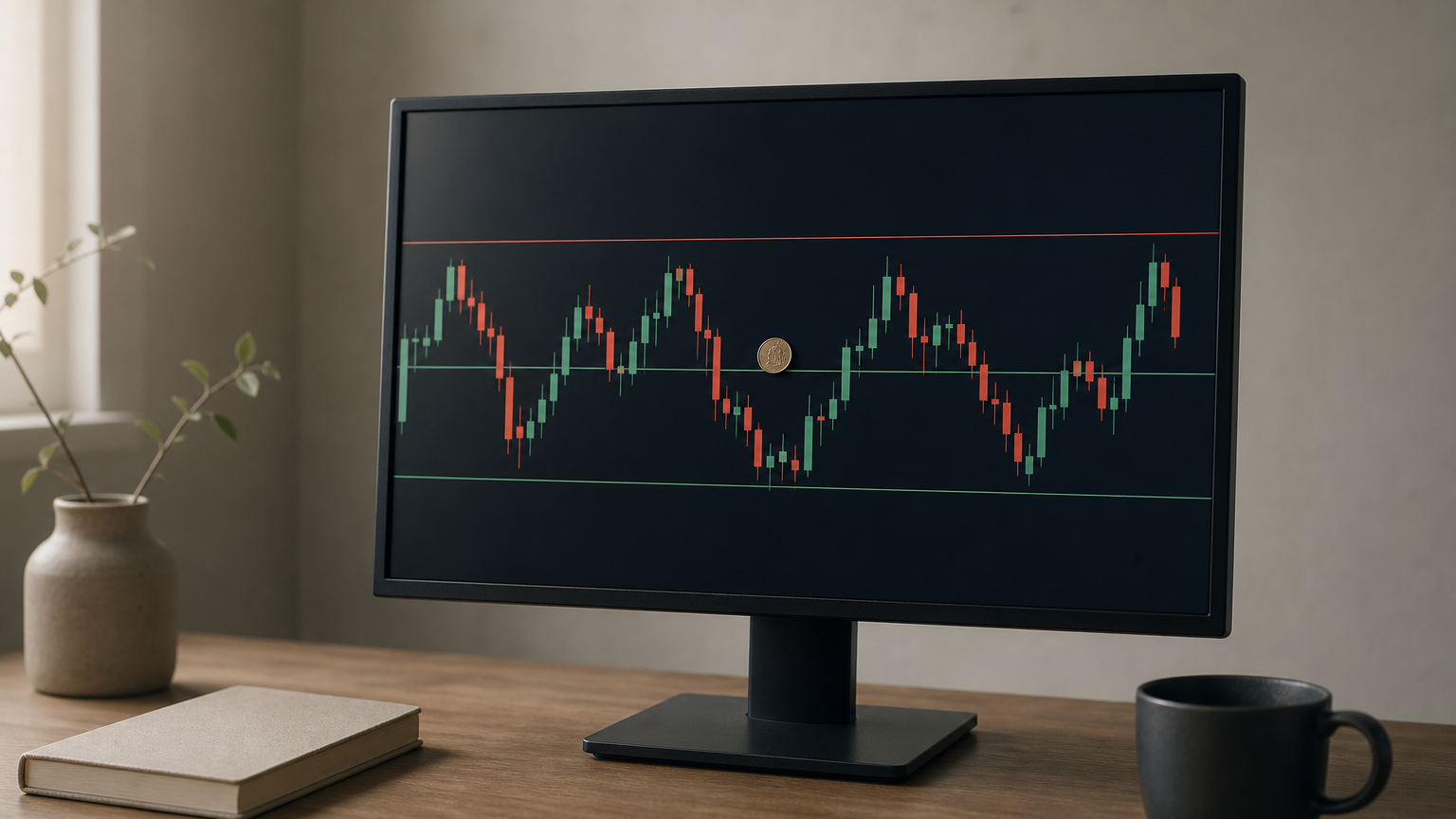
Bollinger Bands wrap a 20-period average with two bands set 2 standard deviations away. In a flat market, price keeps snapping back toward the middle line, so you fade the outer bands. For quiet sessions, when trend setups stall, this is the best scalping forex strategy on the list.
Best timeframes and pairs
Quiet pairs behave best. EUR/USD, EUR/GBP, and USD/CHF range cleanly during the Asian session, roughly 8:00 p.m. to 2:00 a.m. ET, and in the late New York afternoon.
| Chart | Setting | Job |
|---|---|---|
| 5-minute | ADX 14 below 20 | Confirms a range |
| 1-minute | Bollinger 20, 2 | Entry and target |
Entry and exit rules
Here is the buy side. Mirror it for sells:
- On the 5-minute chart, confirm ADX is below 20 and the middle band is flat.
- On the 1-minute chart, wait for a candle to close below the lower band.
- Enter when the next candle closes back inside the band.
- Place your stop 3 to 4 pips below the extreme of the move.
- Take profit at the middle band, usually 4 to 6 pips, and skip the trade if that is under 3 pips.
Who it suits
Patient, selective traders do well here, especially anyone who dislikes chasing fast moves. It also fits you if your only free hours are late evening, since the Asian session is when ranges form.
Main risks
Band walking is the killer. In a strong trend, price hugs the outer band and keeps running, so each fade stacks another loss.
Fade the bands only when the market is flat, never when it is trending.
Ranges also break without warning at news releases. Exit at once if a candle closes well outside the band with a large body. Risk 1% to 2% per trade, because forex and CFD trading carries significant risk.
7. Price action and support and resistance scalping
How it works
Price action scalping drops the indicators and reads the candles. You mark horizontal support and resistance levels where price reversed before, then trade the reaction when it returns. Many traders settle on this as their best scalping strategy once they learn to read candles, because the chart stays clean and every trade has a visible reason.
Best timeframes and pairs
Mark your levels on the 15-minute chart, then execute on the 1-minute or 5-minute chart. Stick to EUR/USD, GBP/USD, and USD/JPY, which respect round numbers like 1.0800 or 150.00 better than thin pairs.
| Chart | Job | What to mark |
|---|---|---|
| 15-minute | Level map | Swing highs and lows, prior day high and low |
| 1-minute | Entry | Rejection candle at the level |
Entry and exit rules
Here is the buy side at support. Mirror it for sells:
- On the 15-minute chart, mark two or three levels near price with at least two prior touches.
- Wait for price to reach a level on the 1-minute chart.
- Enter when a pin bar or bullish engulfing candle closes with a long wick rejecting the level.
- Place your stop 2 to 3 pips beyond the wick.
- Take profit at the next level or 5 to 8 pips, and skip the trade if the reward is under 1.5 times your stop.
Who it suits
Discretionary traders who enjoy reading candles will like this one. It rewards screen time and pattern recognition more than any rule set on this list.
Expect a learning curve. Backtest at least 50 setups on a demo or a Cent account before you raise your size.
Main risks
Levels break, and the third or fourth touch is often the one that fails. Price then runs through your stop and keeps going.
A level is a zone where price may react, not a wall that must hold.
Skip trades during news releases, and treat a candle that closes beyond the level as your exit signal. Risk 1% to 2% per trade, because forex and CFD trading carries significant risk.
8. Volume and momentum confirmation scalping
How it works
Spot forex has no central exchange, so you read tick volume, which counts price updates per candle. It is a solid proxy for activity. This method pairs a simple price trigger with a volume spike and a momentum reading, and it only trades when all three agree, which filters out weak moves.
A move backed by volume and momentum is worth trading, and a move without them is noise.
Best timeframes and pairs
Run the 1-minute chart for entries and the 5-minute chart for direction. Tick volume is most reliable on EUR/USD, GBP/USD, and USD/JPY during the London and New York overlap, when real participation is highest.
| Tool | Setting | Job |
|---|---|---|
| 5-minute 50 EMA | Slope and price side | Trend direction |
| Tick volume | 20-bar moving average | Spike confirms interest |
| MACD | 12, 26, 9 | Histogram confirms momentum |
Entry and exit rules
Here is the buy side. Mirror it for sells:
- On the 5-minute chart, confirm price is above the 50 EMA.
- On the 1-minute chart, mark the high of the last 10 candles.
- Enter when a candle closes above that high, tick volume is at least 1.5 times its 20-bar average, and the MACD histogram is rising above zero.
- Place your stop 4 to 5 pips below the breakout candle’s low.
- Take profit at 5 to 7 pips, or exit if volume fades and the histogram shrinks for two candles.
Who it suits
Traders who already use breakout or pullback setups will get the most from it. If you are working through this top 10 scalping strategy list, treat it as a confirmation filter for strategies 4 and 5. It also suits anyone who wants fewer false entries and accepts fewer trades.
Main risks
Tick volume is not true volume, and feeds differ between brokers. Test the setup on your own platform before trusting it. Volume also spikes at news releases, which can give a false green light right before a reversal.
Skip scheduled releases and quiet sessions where volume never rises above average. Risk 1% to 2% per trade, because forex and CFD trading carries significant risk.
9. Stochastic oscillator scalping
How it works
The stochastic compares the latest close with the recent high-low range on a 0 to 100 scale. Above 80, price sits near the top of its range. Below 20, it sits near the bottom. For scalping, use a fast 5,3,3 setting so the lines react within a few candles.
Alone, it fires too early in trends. Add a trend filter and you only take oversold buys in an uptrend. That makes it the best strategy for scalping pullbacks with precise timing, and a serious contender for the best scalping trading strategy if timing is your weak spot.
Best timeframes and pairs
Use the 5-minute chart for direction and the 1-minute chart for entries. EUR/USD, GBP/USD, and USD/JPY give the smoothest oscillator swings during the London and New York overlap.
| Chart | Tool | Job |
|---|---|---|
| 5-minute | 50 EMA | Trend direction |
| 1-minute | Stochastic 5,3,3 | Entry timing |
Entry and exit rules
Here is the buy side. Mirror it for sells:
- On the 5-minute chart, confirm price is above the 50 EMA.
- On the 1-minute chart, wait for the stochastic to drop below 20.
- Enter when %K crosses above %D and both lines climb back above 20.
- Place your stop 4 to 5 pips below the swing low.
- Take profit at 5 to 6 pips, or exit when the stochastic reaches 80.
Who it suits
Timing-focused traders get the most from this setup. If you like buying dips but want a clearer trigger than a candle pattern, the two crossing lines supply it.
It also suits small-account practice. Run it on a Cent account from 1 USD until you have 30 logged trades.
Main risks
Stuck readings are the main problem. In a strong trend, the stochastic can sit above 80 or below 20 for many candles in a row, so counter-trend signals fail again and again.
An oversold reading in a downtrend is a warning, not a buy signal.
Skip the setup when the 50 EMA is flat or news is due. Risk 1% to 2% per trade, because forex and CFD trading carries significant risk.
10. Zigzag swing scalping
How it works
The ZigZag indicator connects major swing highs and lows and filters out small noise, so trend structure becomes obvious. Higher highs and higher lows mean an uptrend. You buy the first break of a swing high after a higher low forms, and you sell the mirror image in a downtrend.
One catch decides everything. The last ZigZag leg repaints while price is still moving, so it can vanish after you act. Trade only confirmed pivots, never the live line.
The ZigZag line maps what already happened, so act on confirmed swings and never on the leg still being drawn.
Best timeframes and pairs
Mark swings on the 5-minute chart and execute on the 1-minute chart. EUR/USD, GBP/USD, and USD/JPY form the cleanest swings during the London and New York overlap.
| Chart | Setting | Job |
|---|---|---|
| 5-minute | ZigZag 12, 5, 3 | Swing structure |
| 1-minute | Last swing high or low | Entry trigger |
Entry and exit rules
Here is the buy side. Mirror it for sells:
- On the 5-minute chart, wait for a confirmed higher high and higher low.
- Mark the last confirmed swing high.
- Enter when a 1-minute candle closes above it.
- Place your stop 2 to 3 pips below the higher low, capped at 6 pips.
- Take profit at the size of the prior swing, usually 5 to 8 pips, or exit if price closes below the higher low.
Who it suits
Structure-minded traders will like this one. If you want the best scalping trading strategy for reading trends without stacking indicators, it deserves a test. It also suits you if you prefer visual swing logic over oscillator levels.
Main risks
Repainting is the first danger. Beginners often enter on a leg that later disappears, then wonder why the backtest looked perfect. Sideways markets are the second, because ZigZag draws meaningless swings in a tight range.
Skip the setup when the 5-minute chart shows no clear sequence of higher or lower swings, and avoid news releases. Risk 1% to 2% per trade, because forex and CFD trading carries significant risk.
Choosing the strategy that fits you
The best scalping trading strategy is the one you can follow the same way every session. Match it to your temperament. Trend followers should start with the EMA pullback or crossover, range traders with Bollinger Bands, and candle readers with support and resistance. Test one setup for 30 logged trades on a small account before you add another.
Whatever you choose, costs and risk decide the result. Tight spreads protect a 5-pip target, and a 1% to 2% risk cap with a stop-loss protects your account. Forex and CFD trading carries significant risk, so keep your size small until your journal proves the edge.
Ready to put a setup to work? Open a ValeTax account, practice on a Cent account from 1 USD, and move to ECN once your rules hold up.