

Forex risk management for beginners rests on three decisions made before every trade: how much to risk, where to place the stop-loss, and how much leverage to use. The article recommends risking 1 percent of the current balance (2 percent at most), then deriving lot size by dividing that dollar amount by stop distance in pips times pip value, always rounding down.
Stops belong at market structure or 1.5 to 2 times ATR, and may only move toward breakeven, never wider. A reward-to-risk ratio of at least 1:2 lowers the break-even win rate to about 33 percent, and expectancy shows why a high win rate with small targets can still lose money.
Leverage matters less than position size, so traders should keep effective leverage under 10:1 and used margin below 10 to 20 percent of equity. A written plan adds daily, weekly and monthly loss limits, rule-based trade management and a weekly journal review. The piece closes with a copyable one-page checklist and invites readers to practice with the ValeTax no deposit bonus, noting that trading carries risk.
Forex Risk Management Position Sizing, Stops, and Leverage
You searched for a risk management forex pdf because you want something concrete to keep, read, and apply. Most guides bury the useful part under theory. Here is the short version, written for beginners who trade with small accounts and cannot afford a few bad weeks.
Forex risk management comes down to three decisions made before every trade: how much you risk, where your stop-loss goes, and how much leverage you use. A common rule is to risk 1 to 2 percent of your balance per trade. On a $500 account, that is $5 to $10. Divide that amount by your stop distance in pips and you get your position size. Keep a reward at least twice your risk, and you can lose more trades than you win and still stay afloat.
Below, we walk through each step with worked examples you can copy into your own one-page checklist or PDF. At ValeTax, we see new traders start with cent accounts and a $1 minimum deposit, with leverage up to 1:2000. That makes these rules essential, not optional. We cover position sizing, stops, leverage, and risk-reward in that order.
Why forex risk management matters for beginners
Beginners rarely lose an account because their analysis was wrong. They lose it because one oversized position turned an ordinary losing trade into a disaster. Even skilled traders lose many trades. What separates them is that their losses stay small enough to survive, so one bad week never ends their trading.
Losses compound against you
The math punishes you after a drawdown. A 50 percent loss does not need a 50 percent gain to fix, it needs 100 percent. The deeper the hole, the steeper the climb back, as this table shows.
| Account loss | Gain needed to break even |
|---|---|
| 10% | 11.1% |
| 20% | 25% |
| 30% | 42.9% |
| 50% | 100% |
| 75% | 300% |
Small losses are easy to recover from, and that is the whole point of position limits. Suppose you start with $1,000 and lose ten trades in a row. At 2 percent risk per trade, you are left with about $817. At 10 percent risk per trade, the same streak leaves about $349. Ten straight losers happens more often than most beginners expect, especially when you trade without a tested plan.
Your first job is not to make money, it is to stay in the game long enough to learn how.
What leverage does to a small account
Leverage makes the danger easy to miss. Say you deposit $500 and use 1:2000 leverage. You can open a 1 lot position on EUR/USD, worth 100,000 units, with only about $50 of margin. The broker lets you do it, but a 50 pip move against you costs $500, which is your entire balance. Risking 1 percent ($5) with the same 50 pip stop means trading 0.01 lot, a position 100 times smaller.
Treat maximum leverage as a ceiling, not a target. Your risk per trade, not the leverage on offer, decides how much you can lose. Cent accounts and a $1 minimum deposit make this easy to practice. You can run your rules with real money at stake and a very small downside.
Why rules beat willpower
Fear and hope make poor trading decisions. After a loss, you want to win it back fast, so you double your size. After a win, you feel invincible and skip your stop. Both habits come from deciding in the moment. Written rules take the decision out of the moment, which is why they matter more than any indicator.
The same applies to free capital. If you claim a bonus and trade it recklessly, you waste the one chance to practice with real market exposure and learn nothing. That is why any risk management for forex trading beginners pdf worth keeping starts with these numbers, then moves on to the calculations.
How to calculate risk per trade
Risk per trade is the dollar amount you accept losing if your stop-loss is hit. You set it before you look at a chart, and it does not grow because a setup looks perfect. If you want to know how to calculate risk management in forex, this is the first number you need, because position size and stop distance both build on it.
Decide the dollar loss you accept first, then let the chart decide the trade size.
The risk per trade formula
Multiply your account balance by the percentage you are willing to lose. The result is your maximum loss in dollars for one trade, and you can copy the line below straight into your own PDF or notes.
Risk amount = Account balance x Risk percentage
Example: $500 x 1% = $5
Here is how the numbers look at common balances. Notice that small accounts mean very small risk amounts, and that is normal.
| Account balance | 1% risk | 2% risk |
|---|---|---|
| $50 | $0.50 | $1 |
| $100 | $1 | $2 |
| $500 | $5 | $10 |
| $1,000 | $10 | $20 |
| $5,000 | $50 | $100 |
The $50 row matters if you trade a no deposit bonus. Risking $0.50 to $1 per trade feels tiny, but it lets you take dozens of trades before the bonus is gone, and that is how you learn.
Choosing your percentage
Beginners should start at 1 percent. At that level, a streak of ten losses costs you roughly 10 percent of your balance, which you can recover from. Treat 2 percent as the ceiling, and only move up to it after you have a few months of results that follow your plan.
Open trades count too. If you hold EUR/USD and GBP/USD long at once, you are really making one bet against the US dollar, so your true risk is closer to double. A practical limit is 3 to 5 percent of your balance in total across all open positions. Recalculate your risk amount from your current balance, not your starting deposit, so your risk shrinks after losses and grows only after wins.
How to size a position step by step
Position size is the number of lots you trade, and it turns your 1 percent rule into something you can act on. You never pick a lot size by feel. You calculate it from your risk amount and your stop distance. Any forex risk management pdf worth printing should put this formula on the first page.
The position size formula
Take the dollar risk from the last section and divide it by what your stop costs per lot. The formula below is easy to copy into your notes.
Lot size = Risk amount / (Stop distance in pips x Pip value per lot)
On USD-quoted pairs like EUR/USD, one pip is worth about $10 per standard lot, $1 per 0.1 lot and $0.10 per 0.01 lot. For pairs such as USD/JPY, pip value shifts with the price, so check the contract specifications in MT4 or MT5 before you trust the number.
A worked example
Say you have a $500 account and risk 1 percent, which is $5. Your EUR/USD setup needs a 25 pip stop. The math is $5 / (25 x $10) = 0.02 lots. If the stop is hit, you lose 25 pips x $0.20, which is exactly $5, or 1 percent of the account.
Now watch what happens when the stop distance changes. The risk stays at $5, and only the size moves.
| Stop distance | Lot size for $5 risk |
|---|---|
| 10 pips | 0.05 |
| 20 pips | 0.025 (round down to 0.02) |
| 25 pips | 0.02 |
| 50 pips | 0.01 |
| 100 pips | 0.005 (too small, skip the trade) |
A wider stop means a smaller position, never a bigger risk.
Five steps to run before every trade
Use this sequence each time. It takes under a minute once you have done it a few times, and it works on any pair and any account size.
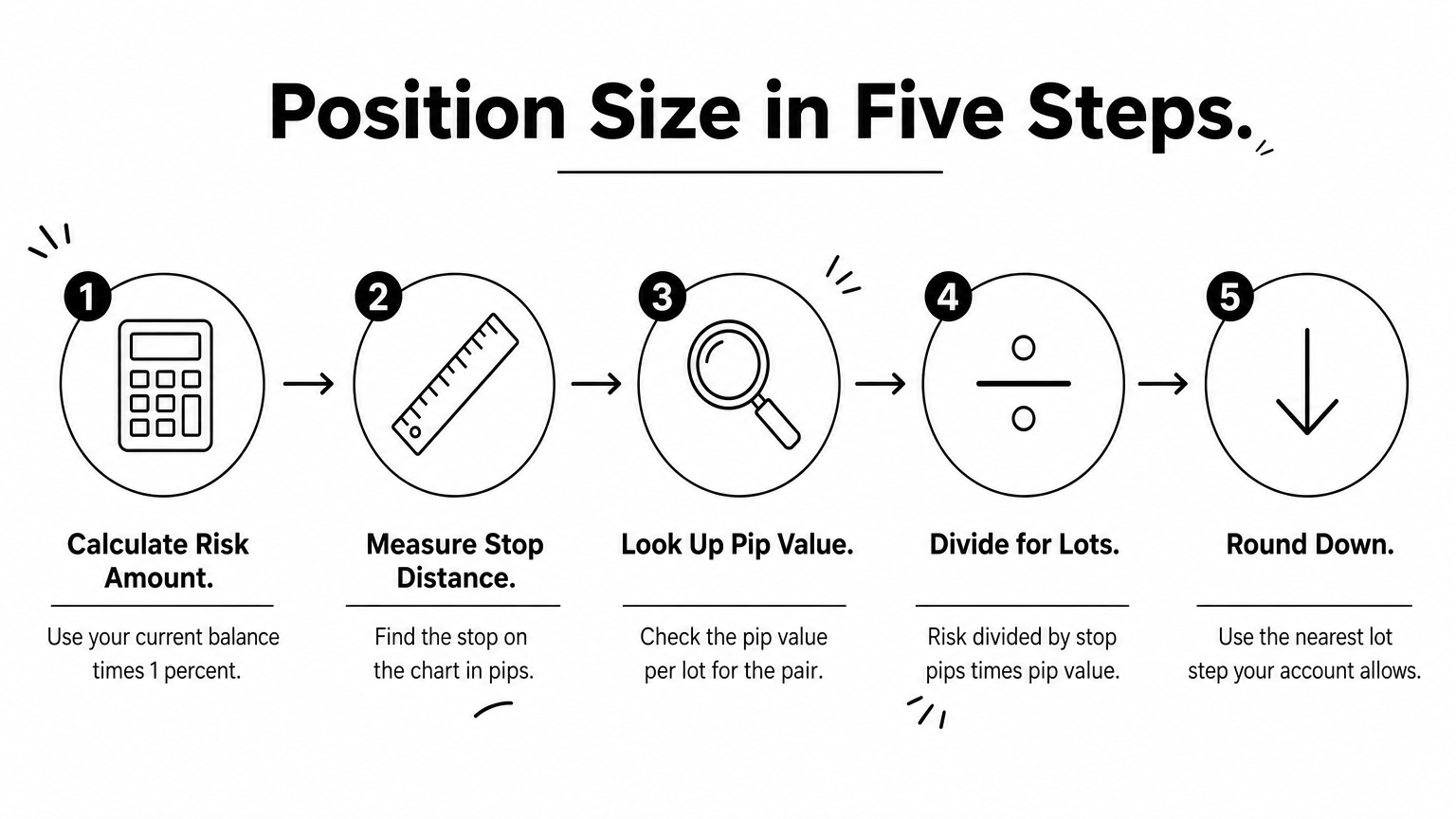
- Calculate your risk amount from your current balance.
- Find your stop level on the chart, then measure the distance in pips.
- Look up the pip value per lot for that pair.
- Divide the risk amount by stop pips times pip value.
- Round down to the nearest lot step your account allows.
Always round down, never up. Rounding 0.025 to 0.03 lots quietly pushes your risk above plan. If the answer falls below your minimum lot size, the stop is too wide for your account. Skip the trade or look for a tighter setup. Do not widen your risk to force an entry.
How to place stop-loss orders that make sense
A stop-loss is an order that closes your trade at a set price, and it only works if you place it where your idea is proven wrong. Many beginners pick a stop based on what loss feels comfortable, then get knocked out by normal noise. Your stop comes from the chart first. Your position size, which you already know how to calculate, adjusts to fit it.
Put the stop where the trade idea fails, then size the position to that distance.
Anchor the stop to market structure
Start with a swing point. For a long trade, place the stop just below the most recent swing low or support level, with a buffer of 5 to 10 pips for spread and wicks. Say you buy EUR/USD at 1.0850 and support sits at 1.0830. A stop at 1.0822 gives you a 28 pip distance. If price trades there, the setup is no longer valid, and you want out.
Volatility matters too. A 15 pip stop on a pair that moves 100 pips a day will be hit by noise. The Average True Range (ATR) indicator, built into MT4 and MT5, shows typical movement for the pair and timeframe. Many traders set the stop at 1.5 to 2 times ATR from entry.
| Method | Where the stop goes | Works best when |
|---|---|---|
| Structure | Beyond the swing high or low | Price respects clear levels |
| ATR | 1.5 to 2 x ATR from entry | Volatility changes often |
| Fixed pips | Same distance every trade | Learning only, then move on |
Mistakes that make stops useless
Most stop errors are habits, not math. Watch for these:
- Moving the stop further away after the trade goes against you.
- Trading with no stop, or a “mental” stop you never honor.
- Placing the stop on an obvious round number like 1.0800, where many orders cluster.
- Using a stop so tight that the spread alone triggers it.
Moving a stop is allowed in one direction only. Shift it toward breakeven after price moves in your favor, never away from entry. Widening a stop turns your 1 percent risk into 3 percent without telling you. Any forex trading risk management strategies pdf you build should state this as a hard rule. Also keep stops in the platform as real orders, so a disconnection or a news spike cannot leave you exposed.
How to set a risk-reward ratio and know your break-even win rate
The risk-reward ratio compares what you risk with what you aim to gain. If your stop is 25 pips away and your target is 50 pips away, the ratio is 1:2, also called 2R. Your stop already fixes the risk side, so the target is the only new number you need to choose.
Find your break-even win rate
Your break-even win rate is the share of trades you must win just to cover your losses. The formula is short, and it belongs in any risk management forex pdf you keep.
Break-even win rate = 1 / (1 + Reward-to-risk ratio)
Example at 1:2: 1 / (1 + 2) = 33.3%
| Reward:risk | Break-even win rate |
|---|---|
| 1:1 | 50% |
| 1:1.5 | 40% |
| 1:2 | 33.3% |
| 1:3 | 25% |
Costs push these numbers up a little. Spreads and commissions act like a small extra loss on every trade, so aim a few points above the table. A bigger ratio is not automatically better either, because a distant target gets reached less often. Treat 1:2 as a sensible minimum while you are learning.
Test your plan with expectancy
Expectancy tells you the average result per trade, measured in units of risk (R). Multiply your win rate by your reward, then subtract your loss rate times one. Say you win 40 percent of trades at 1:2. That is (0.4 x 2) – (0.6 x 1) = +0.2R per trade. With $5 risked each time, you average $1 per trade, or about $100 over 100 trades.
Now flip it. Win 60 percent of trades but target only half your risk, a 1:0.5 ratio. The math is (0.6 x 0.5) – (0.4 x 1) = -0.1R per trade. You win most of your trades and still lose money.
A high win rate means nothing until you know the ratio attached to it.
Place targets at real levels, such as the next resistance for a long trade, not at a number you wish for. If the nearest level gives you less than 1:2, skip the setup. Then log at least 50 trades on a demo or small live account, so your own win rate replaces guesses.
How to manage leverage and margin safely
Leverage is borrowed buying power, and margin is the deposit your broker locks up to keep a trade open. If you size every trade from a 1 percent risk, leverage itself stops being your main danger. The real threat is margin. Too many open trades leave you with little free margin, and a margin call or stop-out can close positions at the worst moment.
Know the margin numbers
Margin depends on lot size, price, and account leverage. Margin level shows how close you are to trouble. Brokers set their own margin call and stop-out levels, so read them in your account terms before you trade. Any risk management in forex trading pdf you build should carry these two formulas.
Required margin = (Lots x 100,000 x Price) / Leverage
Margin level = (Equity / Used margin) x 100
Example: 0.02 lot EUR/USD at 1.0850, 1:500
(2,000 x 1.0850) / 500 = $4.34
That trade ties up about $4 of a $500 account. Margin is not your loss. Your loss is set by the stop, and the margin only decides how many trades you can hold at once.
Measure your effective leverage
Effective leverage is total position value divided by your balance. It tells you the real exposure, whatever maximum your broker offers. Here is how it looks on a $500 account trading EUR/USD at 1.0850.

| Position size | Position value | Effective leverage |
|---|---|---|
| 0.02 lot | $2,170 | 4.3:1 |
| 0.10 lot | $10,850 | 21.7:1 |
| 1.00 lot | $108,500 | 217:1 |
A position sized for 1 percent risk with a 25 pip stop lands near the first row, even on a 1:2000 account. Tight stops push effective leverage up, so check it on every trade. As a beginner guide, keep it under 10:1 across all open positions.
Your margin level is a warning light, and a position sized by risk rarely switches it on.
Rules that protect your margin
Use these limits to keep a buffer between you and a stop-out:
- Keep total used margin below 10 to 20 percent of your equity.
- Never add to a losing trade to “average down”.
- Check the margin level before major news releases, when spreads widen and prices gap.
- Lower your account leverage if your platform or broker allows it, so a sizing mistake costs less.
Finally, hold back some free margin for the unexpected. If one more trade would drop your margin level close to your broker’s margin call line, skip it. A missed setup costs you nothing, while a forced close costs you the account.
Risk management strategies and rules to put in your plan
Sizing and stops protect single trades. A plan protects the whole account across days and weeks. The rules below turn your numbers into written limits you follow without debate, which is where most beginners slip.
Set loss limits that end a bad day
Daily and weekly caps stop a losing streak from snowballing. Express them in R, your risk per trade, so they scale as your balance changes. Here is a starting set for a $500 account risking 1 percent per trade.

| Limit | Rule | Dollar amount |
|---|---|---|
| Daily loss | 3R (3%) | $15 |
| Weekly loss | 6R (6%) | $30 |
| Monthly drawdown | 10% | $50 |
| Losing streak | 3 losses in a row | Stop for the day |
When you hit a limit, close the platform and walk away. Chasing losses is when traders double their size and break every other rule they wrote.
A loss limit only works if you honor it the moment it is hit.
Manage open trades by rules, not mood
Once you are in a trade, decisions get emotional fast. Decide your management in advance, so the plan acts and you do not. These rules work for most beginners:
- Move the stop to breakeven after price moves 1R in your favor.
- Close half the position at 1R and let the rest run toward 2R or more.
- Hold no more than 2 or 3 positions at once, and count correlated pairs as one.
- Stay out of new trades 15 to 30 minutes before high-impact news.
- Trade liquid pairs such as EUR/USD, GBP/USD and USD/JPY, where spreads stay tight.
Partial profits lower your average reward a little, but they protect your confidence, and confidence is what keeps you following the plan.
Keep a journal and review it weekly
A risk management in forex trading pdf download gives you the rules. Your journal proves whether you follow them. Log the date, pair, entry, stop, lot size, risk in R, result, and one line on whether you broke any rule. Each entry takes about a minute.
Review the log every weekend. Count how many losses came from valid setups and how many came from rule breaks. If most of your damage comes from broken rules, the fix is discipline, not a new strategy. If your rules held and you still lost, your edge may need work, and 50 logged trades will show it.
A one-page risk management checklist you can copy
Everything in this guide fits on one page. Paste the template below into a document, fill in your numbers, and save it as your own risk management forex pdf. Because you write it yourself, it matches your balance and your rules, not someone else’s.
Copy this template
Copy the block, then replace the blanks. The example values suit a $500 account and a beginner who risks 1 percent per trade. Change them only after you have logged 50 trades that follow the plan.
MY FOREX RISK MANAGEMENT CHECKLIST

BEFORE EVERY TRADE
[ ] Risk per trade: 1% of current balance = $___
[ ] Stop-loss set at structure or 1.5-2 x ATR
[ ] Lot size = risk / (stop pips x pip value), rounded down
[ ] Target gives at least 1:2 reward-to-risk
[ ] Total open risk under 3-5% of balance
[ ] Effective leverage under 10:1
[ ] Used margin under 10-20% of equity
[ ] No high-impact news in the next 15-30 minutes

AFTER ENTRY
[ ] Stop moves toward breakeven only, never wider
[ ] Stop to breakeven at +1R, half off at 1R

HARD LIMITS
[ ] Daily loss 3R | Weekly loss 6R | Monthly drawdown 10%
[ ] 3 losses in a row = done for the day

REVIEW
[ ] Log every trade, check rule breaks every weekend
How to use it
Print it or pin it beside your screen. Run the “Before every trade” lines each time, and tick every box before you click buy or sell. If you cannot tick one, you skip the trade. That single habit stops most impulsive entries.
Write your rules while you are calm, because you will not write them well after a loss.
Revisit the page once a month, not once a day. Change a number only when your journal gives a reason, for example a stop that keeps getting hit by normal noise. Never loosen a limit because you feel unlucky. If you trade a small bonus balance, scale the dollar amounts down and keep the percentages the same.
Putting your risk rules to work
Good forex risk management comes down to a few numbers you set before every trade. Risk 1 percent of your balance, size the position from your stop distance, and target at least 1:2 reward-to-risk. Keep your real leverage low, whatever your account allows, and write your daily and weekly loss limits down.
Your one-page checklist turns those numbers into habit. Save it as your own PDF and tick every box before each entry. Then review your journal every weekend, because discipline, not a clever indicator, keeps an account alive.
Ready to practice with real market exposure? Open an account and claim the ValeTax No Deposit Bonus to apply these rules in live conditions without funding the account yourself. Start small, follow your plan, and let the results build your confidence. Trading involves risk, and the bonus is subject to ValeTax terms.