


Forex execution infrastructure is one of the most important, and most overlooked, parts of a trader’s setup. Professional traders often spend hours refining entry and exit rules, testing indicators, and tuning algorithms. Yet the broker’s execution model shapes every trade and affects your results long before a strategy is judged on its signals.
In the trading environment of 2027, understanding how orders are processed is a practical step toward a structured trading approach. This article explains how execution models work, where hidden costs tend to appear, and what to check before you commit capital. Use it as a checklist as much as an explanation.
Execution and Structural Efficiency
Consider a systematic strategy that identifies a market movement and sends an order. The strategy’s logic ends at the moment of the decision. Everything after that, including routing, pricing, and the final fill, depends on the broker’s forex execution infrastructure.
If that infrastructure is not well designed, the price you requested and the price you actually receive can differ. That gap, known as slippage, is a structural cost that does not appear as a commission line on your statement. It is easy to miss because it is spread across individual trades rather than billed as a single charge.
Why Slippage Matters Over Time
A single fill that differs from the requested price may seem minor. Over a large sample of trades, however, small differences add up and can affect how closely live results match backtested results. A strategy that looks profitable on historical data may underperform live if fills consistently come in worse than the model assumed.
This is why execution consistency matters as much as the strategy itself. Three factors tend to drive the gap between expected and actual execution:
- Requested price vs. fill price: the gap shows how orders are handled at the moment of execution.
- Spread behavior: spreads can widen during high-impact news, changing the cost of every entry and exit.
- Order handling delays: delays can shift your fill into a less favorable price range.
Structural Considerations in Forex Execution Infrastructure
Many retail environments use a model where order flow is internalized. In this framework, the broker may act as the counterparty to the trade. This model is common, but it can create potential conflicts of interest, because the broker’s gains and the client’s losses may be linked.
These conflicts tend to be most visible during periods of increased volatility. In such conditions, internalized environments may show variations in spreads or delays in order handling, and these changes can influence the execution conditions you face. Understanding this dynamic helps you ask better questions before you open an account.
For background on how the wider currency market is structured and measured, the Bank for International Settlements publishes research on foreign exchange market activity that is useful for context.
Internalized Model vs. A-Book ECN/STP
To reduce these concerns, many professional market participants move toward an A-Book ECN/STP framework. In this structure, the broker passes client orders to external liquidity providers rather than taking the other side of the trade. The table below summarizes the general differences.
| Feature | Internalized (B-Book style) | A-Book ECN/STP |
|---|---|---|
| Counterparty | Broker may be the counterparty | External liquidity providers |
| Order routing | Handled within the broker’s own flow | Routed directly to external liquidity |
| Pricing source | Broker-managed pricing | Market-driven pricing |
| Conflict of interest | Potentially present | Designed to reduce it |
How an A-Book ECN/STP Setup Works
The tegasFX infrastructure operates within an A-Book ECN/STP structure. Its key principles, as described by the provider, are:
- Direct routing: orders are routed directly to external liquidity providers.
- No intervention: no dealing desk intervention is applied to the order flow.
- Market-driven pricing: execution is based on market-driven pricing.
This setup provides several structural characteristics. Pricing is sourced from external liquidity providers so that it reflects real-time market conditions. The execution environment is described as designed to support low-latency execution, and the infrastructure is described as supporting automated and systematic trading approaches.
Broker revenue is primarily generated through trading volume commissions. In practical terms, the broker earns when you trade rather than when you lose. This alignment is a central reason the ECN/STP model is often preferred by systematic traders, although it does not remove every cost. If you want to compare how STP and ECN accounts differ in fees and spreads, see our guide to KCM Trade Fees and Spreads 2027: STP vs ECN Account Comparison.
Before relying on any of these features, check the current conditions directly with the provider, including commission schedules and any account-specific terms. Conditions can change, and the official documentation is the reference point.
Flexibility in Leverage and Risk Management
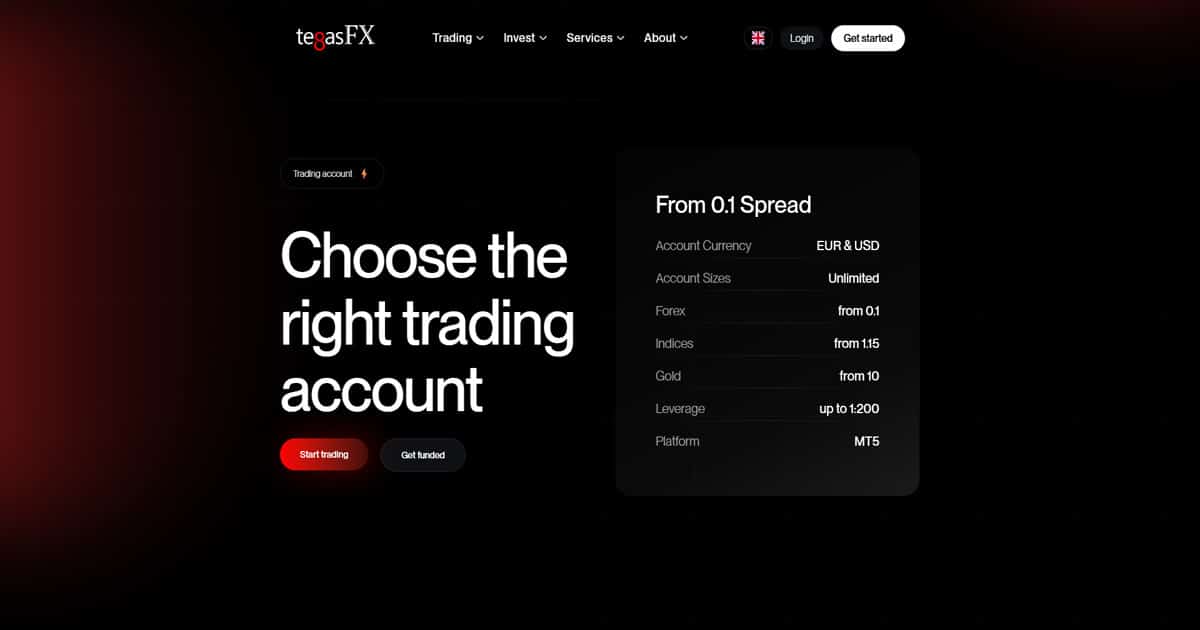
Managing capital efficiency also depends on how your trading account is configured. Modern ECN environments usually offer flexible parameters so that different trading styles can be supported. At tegasFX, leverage is structured based on account configuration, which allows traders to match their settings to their approach.
Leverage magnifies both gains and losses. The same execution quality can therefore produce very different outcomes depending on how much exposure a trader carries. Match your account settings to your position sizing and stop placement rather than choosing the highest available figure.
Structured Drawdown Models
The tegasFX infrastructure includes structured drawdown models ranging from 5 percent to 40 percent. A drawdown model defines the maximum loss the account can absorb before limits apply, so choosing the right level is a risk decision as much as a technical one.
These defined parameters help you operate within clear risk boundaries while keeping your technical edge. A lower drawdown level may suit cautious traders testing a new system, while a higher level may suit those with a longer horizon and a tested plan. For a deeper look at sizing trades against your account, see our guide on Forex Risk Management: Position Sizing, Stops, and Leverage.
Operational Stability and Fund Structure
Trading conditions are only one part of a broader operational framework. The long-term reliability of a provider depends on its track record and on the stability of its banking relationships. According to the provider, tegasFX has been active since 2016 and focuses on maintaining a stable infrastructure and structured operational processes.
A key benchmark for stability is where client funds are held. According to the provider, client funds are held with DBS Bank in Singapore. Payouts are processed according to defined operational procedures once participation requirements are met.
Review these procedures in the provider’s official documentation before you deposit, and confirm the fund custody arrangements yourself. Verifying this information is a basic step that takes only a few minutes.
A Step-by-Step Checklist for Evaluating Execution
You can assess a broker’s execution infrastructure with a few practical checks. Work through them in order before you fund an account:
- Ask how orders are routed. Find out whether the broker operates as an A-Book, B-Book, or hybrid.
- Compare spreads during news. Look at spread behavior during high-impact releases, not only during quiet hours.
- Track slippage in a demo or small live account. Log requested and filled prices for at least several weeks.
- Review leverage and drawdown settings. Make sure the account configuration matches your risk plan.
- Verify fund custody and withdrawal terms. Read the official policies on banking and payouts.
If you are comparing options across the market, our forex broker review section on choosing a trading platform can help you narrow the field before you run these tests.
Final Perspective on Market Infrastructure
If a systematic strategy performs differently in live markets than in testing, the execution model may be a contributing factor. Slippage, spread widening, and order delays can all erode results without appearing as an obvious fee. Moving to an ECN/STP environment is a sensible step for traders who want to optimize the structure of their trading setup.
Reviewing transparent execution conditions and scalable infrastructure gives you a clear reference point for today’s markets. Choosing a partner that values structural transparency and execution consistency is a logical step for anyone seeking a professional trading environment.
FAQ
What is forex execution infrastructure?
Forex execution infrastructure is the set of systems and processes that route, price, and fill your orders. It includes the broker’s liquidity sources, order routing method, and how spreads and delays are handled.
What is the difference between A-Book and B-Book execution?
In an A-Book model, orders are passed to external liquidity providers. In a B-Book or internalized model, the broker may act as the counterparty to the trade, which can create potential conflicts of interest.
What causes slippage in forex trading?
Slippage occurs when the fill price differs from the requested price. It can be affected by volatility, spread changes, and order handling delays, especially during major news events.
Why does a drawdown model matter?
A drawdown model sets the maximum loss an account can absorb under defined rules. Choosing a suitable level helps you manage risk within clear parameters.
How can I check where my funds are held?
Check the broker’s official documentation for fund custody details and banking partners. Confirm this information directly with the provider before depositing.
Does an ECN account always mean lower costs?
Not necessarily. ECN and STP accounts typically use market-based pricing and commission-based revenue, but total costs depend on spreads, commissions, and your trading volume. Compare the full cost structure before deciding.