


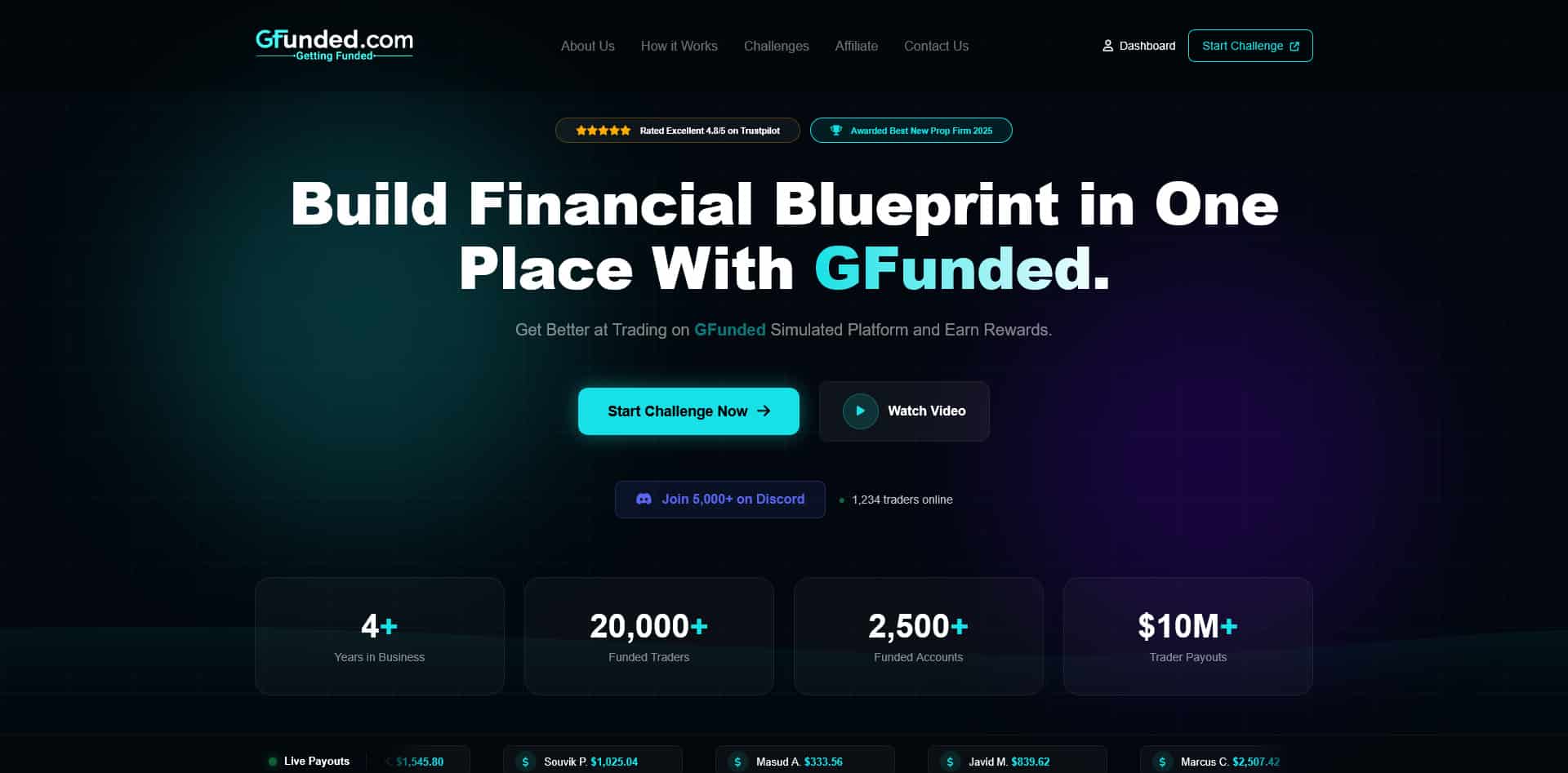
GFunded is a retail prop firm that gives traders access to large simulated accounts once they pass its evaluations. Accounts range from $10,000 to $200,000, and the firm charges a one-time fee instead of monthly subscriptions. This review explains how the model works, what the rules really demand, and where the program suits traders and where it does not.
The firm reports more than 400,000 funded traders, over $10M paid out, and a 4.8/5 rating on Trustpilot. We could not independently verify those figures, so treat them as the firm’s own claims. Our goal is to show what works, what doesn’t, and whether this platform matches your professional trading goals.
What Is GFunded and How the Model Works
GFunded works differently from regular trading because you do not risk your own deposit to trade the firm’s capital. Your trading skill, not your bank balance, determines how much you can earn. You prove that skill during an evaluation, then trade a funded account.
Simulated accounts with real payouts
During evaluation, you trade a simulated environment that mirrors live market behavior. You do not use real market capital at this stage. After you pass and receive a funded account, GFunded puts its capital behind your trades, and you earn real money based on your results.
One-time fee model
You pay once to join the evaluation program, unlike platforms that charge monthly. The fee rises with account size, so bigger accounts cost more. Traders often find this structure helpful because it:
- Avoids monthly fees eating into profits
- Makes budgeting easier with a single payment
- Lets you trade at your own pace without monthly target pressure
Evaluation vs Instant Funding
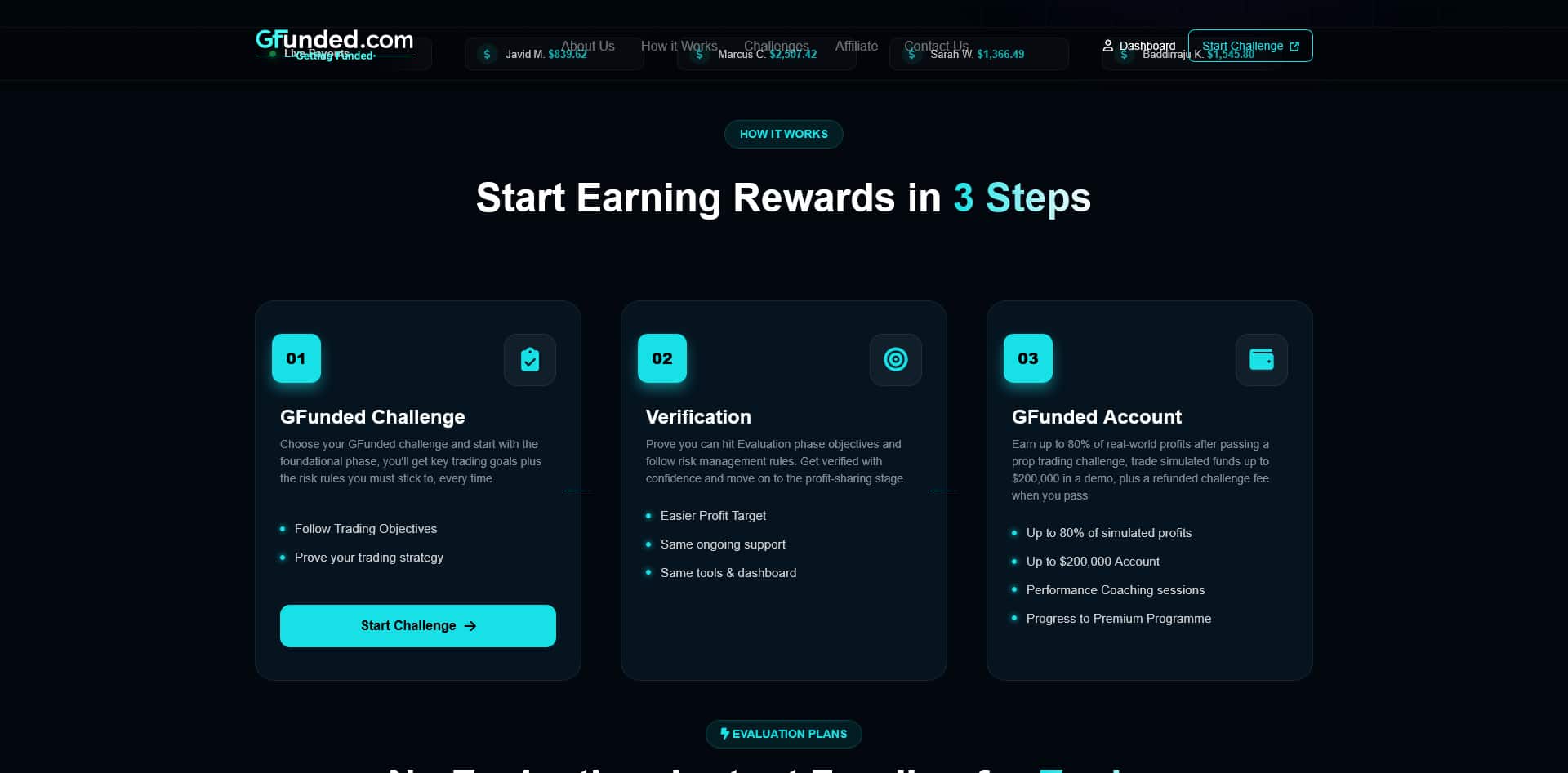
GFunded offers two routes to funding. Evaluation programs cost less upfront and require you to pass a challenge first. Instant Funding gets you a funded account right away, but it costs more and has stricter trading rules.
The evaluation model filters for disciplined traders, while Instant Funding suits experienced traders who want immediate access. Both routes aim to find skilled traders who manage risk well.
GFunded Plan Types: 1-Step, 2-Step and Instant Funding
Each GFunded plan suits a different trading style and risk tolerance. We reviewed all three options to see how their rules work in practice.
| Plan | Profit target | Key feature |
|---|---|---|
| 1-Step | 10% in one phase | Fastest route, tighter consistency rule (about 20%) |
| 2-Step | 8% in Step 1, 4-6% in Step 2 | Two phases, at least 3 trading days per phase |
| Instant Funding | No profit target | Immediate access, tighter daily and maximum drawdown limits |
1-Step: fast track with strict rules
The 1-Step evaluation is the quickest way to funding if you can handle strict rules. You pass one phase with a 10% profit target while staying within daily and maximum drawdown limits. Usually you need about 5-10 trading days, and there are no time limits on reaching the target.
The catch is the consistency rule. On a $50K account, you need $5,000 in profit without breaching a 6% maximum drawdown (about $3,000). One trader told us, “The 1-Step saved me time, but forced me to be much more selective with entries.”
2-Step: slower pace, more flexibility
The 2-Step evaluation splits the challenge into two phases, which many traders find easier mentally. On a $200K account, you need $16,000 profit (8%) in Step 1, then $12,000 (6%) in Step 2. Each phase requires at least three trading days.
Instant Funding: no target, tighter limits
Instant Funding lets you start trading immediately and withdraw profits without hitting a target first. The trade-off is tighter risk control, with daily drawdown usually at 2-4% and maximum drawdown at 4-10%, depending on the plan. A $100K account with a 3% daily limit and 6% maximum drawdown gives you $3,000 and $6,000 buffers.
Some plans require 5-7 trading days before profits can be taken. Instant Funding costs more upfront because you get immediate access and the firm takes on more risk.
Account Rules: Profit Targets, Drawdown and Consistency
Success with GFunded depends on mastering a small set of rules. Understanding them early helps you avoid account closure and improves your chances of funding.
Profit target: 10% explained
The evaluation profit target is usually 10% of your account balance, regardless of size. A $50K account needs $5,000, while a $200K account needs $20,000. Rushing to hit it often backfires. If you average $1,000 a day on a $200K account, you would reach the target in about 20 trading days, which is a steadier pace.
Daily loss and maximum loss limits
GFunded uses two main risk controls. Daily loss limits usually sit between 3-5% of your balance, so a $100K account might allow a $3,000-$5,000 daily loss. Maximum drawdown typically ranges from 8-12% of the original balance. On a $50K account with a 10% maximum drawdown, your account closes if equity falls to $45,000 or below.
Trailing vs static drawdown
Static drawdown stays fixed at a set percentage of your original balance. A $100K account with an $8,000 static drawdown can never drop below $92,000, even if the balance grows to $110,000.
Trailing drawdown moves up as profits grow. On the same account, if your balance reaches $104,000, the new floor becomes $96,000, and it stays there even if your balance falls. Trailing models reward consistency but leave less room for error. For background on how drawdown is measured across trading, see Investopedia.
Equity vs balance tracking
Balance reflects only closed trades. Equity adds unrealized profit or loss from open positions. If GFunded measures drawdown on equity, a temporary dip in an open trade could breach your limit even if you never close that loss. This matters most for overnight positions, where gaps can trigger violations before you can react.
Consistency rule: the 20% cap
No single day’s profit can exceed 20% of your total profit. If your total profit is $10,000, your biggest single-day gain must stay under $2,000. To check compliance:
- Find your highest single-day profit
- Divide it by 0.20 to get the minimum total profit needed
- Keep making smaller profitable trades until you comply
For example, a $3,000 profit day requires at least $15,000 in total profits ($3,000 ÷ 0.20) before a payout request. This rule discourages relying on one lucky trade.
Small But Critical Rules That Can Cause Failure
Traders are sometimes disqualified for breaking rules that are easy to miss, even after hitting targets and staying within drawdown limits.
Minimum trading days and inactivity
Most evaluation accounts require 3-7 trading days. Some firms also ask for at least 0.5% profit of the original balance on those days. Accounts are flagged as inactive if no trade is placed within a set period, usually 30 days, and this applies to both evaluation and funded accounts. A simple habit solves this: place a small trade before the timer runs out.
News trading restrictions
Most firms, including GFunded’s standard rules, block opening or closing positions 2 minutes before and after major economic announcements. This covers manual trades, stop-losses, take-profits and pending orders. Breaking this rule can end your account regardless of profit, because news often brings volatility and price gaps that demo environments cannot fully replicate.
Stop-loss requirements
You need a stop-loss on every trade. GFunded classifies a missing stop-loss as a “soft breach”, so your account is not closed immediately. However, repeated violations can still lead to disqualification after review. Stop-losses protect you when markets gap overnight or move unexpectedly.
GFunded Pricing, Profit Split and Add-Ons
GFunded’s pricing is tiered by account size, and the total cost is a single payment. Knowing the full figure upfront prevents surprises.
Plan pricing examples
A Standard Plan-4 $50K account costs $375 one time. It carries a 10% profit target, a 5% daily loss limit and a 6% maximum loss limit, with no minimum trading day requirement. Across the range, the firm lists fees between $95 and $925 for accounts from $10,000 to $200,000. The materials we reviewed did not give an exact price for the $200K tier, so check the current price on the GFunded site.
The 80% profit split
GFunded advertises an 80% profit split at every account size. On a $50K account, you keep 80% of trading profits and the firm keeps 20%. Market splits commonly range from 70% to 90%, so this is competitive.
Refundable fee conditions
GFunded states that evaluation fees are 100% refundable for accounts of all sizes once traders show consistent profits. The refund covers only the original evaluation fee, not add-ons. Other firms set different conditions. Goat Funded Trader, for example, refunds after the fourth payout, while FundedNext Futures offers no refund.
Add-ons: news access, resets and payouts
News trading access is included with all plans, which many competitors do not allow. Reset options let you restart after a rule breach without buying a new challenge. Buy reset add-ons before any violation. The materials did not list GFunded’s reset price.
Payout frequency varies. Some firms speed payouts up to every 7 days, compared with the usual 14-30 day cycle. GFunded also includes weekend holding and 24/7 support, which means you do not pay extra for basic services.
Trading Platforms and Execution Quality
Your platform affects execution quality and, in turn, your ability to hit profit targets. GFunded offers several platforms, each with a different strength.
TradeLocker, MatchTrader and DXTrade compared
TradeLocker suits casual traders and longer-timeframe strategies. It has decent execution speed, auto-reconnect and customizable indicators, with ease of use as its focus.
MatchTrader stands out for speed. Its matching engine is reported to handle over 50,000 transactions per second with latency under 3 milliseconds, which helps during volatile markets. It is mobile-first and includes TradingView charts.
DXTrade is a multi-asset platform with a customizable interface. Many traders still prefer MetaTrader 4/5 for reliability, and newer platforms can show occasional bugs or stability issues.
Spreads, slippage and commissions
Spreads directly affect your results. Major pairs usually have tighter spreads than exotic pairs, and spreads narrow when the London and New York sessions overlap. They widen during quiet hours and around major news. Fixed spreads give consistent costs at higher rates, while variable spreads move with market conditions.
Some firms charge raw spreads plus commission. For example, at USD 5.00 per round lot, 1 lot of EURUSD with a 0.2 pip spread costs USD 2.00 in spread plus USD 5.00 in commission, a total of USD 7.00.
Platform behavior during volatility
In our view, platform choice matters most during fast markets. Test execution during your own trading hours, because a platform that works well in European sessions may lag during Asian hours due to liquidity differences.
Payout Process: What to Expect After You Pass
The real reward is withdrawing profit from your funded account. Knowing the process helps you avoid delays.
Payout request flow and KYC
Start from the “Payout” or “Withdrawal” section of your dashboard. Close all open trades first, since open positions trigger automatic rejection. Processing takes 24-48 hours before funds move to your payment method. Most prop firms pay twice a month, usually on the 14th and 28th.
Before your first withdrawal, complete KYC verification. You will typically need:
- A valid government-issued ID
- Recent proof of address, such as a utility bill or bank statement from the last 3 months
- Facial recognition in some cases
Verification usually takes 24-72 hours. International traders may need extra documents, and a payment account through a provider such as RiseWorks may be required.
Payout delays and minimum withdrawals
Missing documents and open positions are the most common causes of delay. Minimum withdrawal amounts vary from $25 to $1,000 depending on the firm and account size. Payment systems do not run on market closures, so weekend requests usually process on the next business day.
How withdrawals affect drawdown
Withdrawals reduce your equity and can narrow the gap to your drawdown limit. Many firms apply a “Locked Upon Payout” rule that freezes trailing drawdown at the starting balance after a withdrawal. For example, a $100,000 account that grows to $120,000 and withdraws $16,000 drops to $104,000. The drawdown stays locked at $100,000, leaving only $4,000 of buffer. Build a cushion before withdrawing, or reduce position size afterward.
Who GFunded Is Best For (and Who Should Avoid It)
Best fit: disciplined, consistent traders
Traders who risk 1-2% per trade and aim for at least a 1:2 risk-to-reward ratio tend to do well here. Many traders struggle with personal accounts but find prop rules help them stick to discipline. Consistency is the foundation of funded success, and those who accept drawdowns as part of the process usually last longer.
Not ideal for: high-frequency or high-drawdown strategies
GFunded bans trades held under 60 seconds, which rules out most high-frequency strategies. Grid trading and aggressive scalping can also lead to termination, no matter how profitable they are. Traders used to 25-40% account swings will find the 10-15% drawdown limits restrictive. For more on managing exposure in these conditions, see our guide to Forex risk management: position sizing, stops and leverage.
Real trader feedback
One trader earned $83,658.28 but ran into trouble after leverage dropped from 1:30 to 1:5. Another turned a $50,000 instant-funded account into a $1,500 payout in two weeks through strict risk management. Failed traders often point to psychology rather than strategy. As one put it, “The challenge is real still, mostly within my head, not with my strategy.”
Conclusion
GFunded keeps its core promises for the right trader. The one-time fee, 80% profit split and reported payouts set it apart, but success requires discipline and a clear grasp of every rule.
Choose your plan based on your style. The 1-Step suits confident traders with proven strategies, the 2-Step is easier for many to handle mentally, and Instant Funding removes the profit target but adds tighter risk limits. If you are comparing other funding offers, our best no-deposit forex bonus list covers different models with their own requirements.
The question is not whether GFunded works, but whether you can adapt to its system. If you can, it offers a structured path to trading serious capital without risking your own.
FAQ
Is trading with a funded prop firm account worth it?
It can be, especially if you have strong skills but limited capital. You get access to larger accounts without risking your own money. Success still depends on your discipline and your ability to follow the firm’s rules.
How do GFunded’s account types differ?
GFunded offers 1-Step, 2-Step and Instant Funding. 1-Step is a fast track with a single 10% target and stricter consistency rules. 2-Step splits the target into two lower phases, and Instant Funding gives immediate access with tighter drawdown limits.
What are the key rules to follow with GFunded?
Core rules include meeting the profit target (typically 10%), staying within daily loss and maximum drawdown limits, and keeping single-day profit under 20% of total profit. You also need minimum trading days, a stop-loss on every trade, and no trading around major news windows.
How does the GFunded payout process work?
Request a payout from your dashboard after closing all open positions and completing KYC verification. Processing usually takes 24-48 hours, and funds then move to your payment method. Your account’s payout schedule and minimum withdrawal amount still apply.
Who is GFunded best suited for?
GFunded suits disciplined traders who manage risk well and have strong skills but limited personal capital. It is less suitable for high-frequency traders or those who need wide drawdown room.